
Reviewed by a Psychology Postgraduate (MA)
IQ gets you hired. EQ gets you promoted. The brilliant jerk stalls; the emotionally skilled rises. Emotional intelligence — understanding and managing emotions (yours and others’) — predicts leadership, relationships, and mental health better than IQ in many domains. And unlike IQ, it’s highly trainable. Here’s the framework.
What it means in one sentence: Emotional intelligence (EQ) is the ability to perceive, understand, manage, and use emotions effectively — in yourself and others.
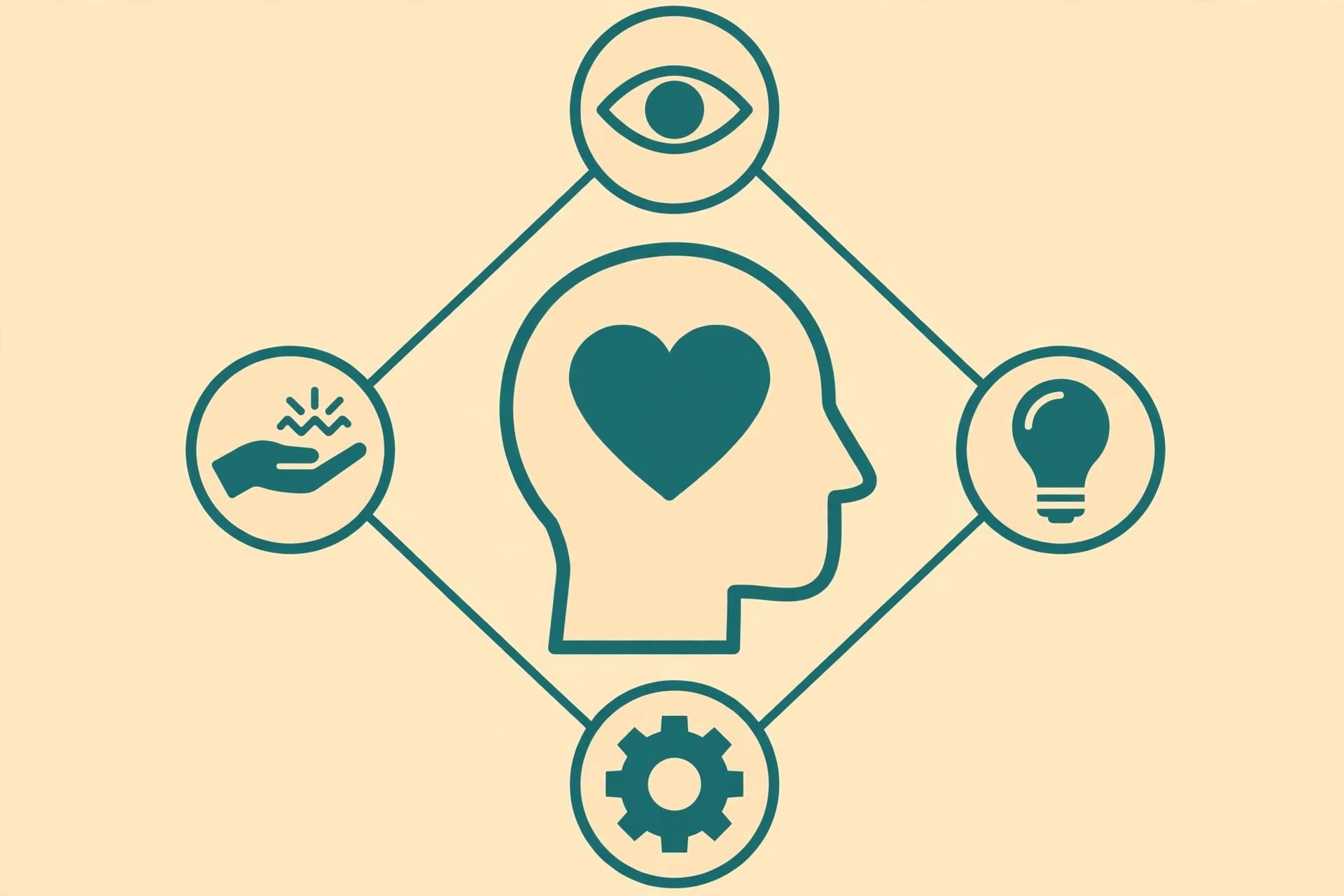
In short: Emotional intelligence is the ability to recognize, understand, and manage emotions — your own and other people’s. Psychologists break it into four skills: self-awareness, self-management, social awareness, and relationship management. EQ predicts leadership and relationship success better than IQ in many domains — and unlike IQ, it is highly trainable.
Emotional Intelligence in Everyday Words
Mayer & Salovey’s four branches: 1. Perceiving: Recognizing emotions — in faces, voices, yourself. (“I’m not ‘fine’ — I’m disappointed.”) 2. Understanding: Knowing how emotions work — causes, progressions (“frustration → anger if ignored“). 3. Managing: Regulating — calming yourself, not suppressing. 4. Using: Harnessing emotions for thinking — excitement fuels creativity, calm aids analysis.
Goleman’s popularization added: self-awareness, self-regulation, motivation, empathy, social skills. The workplace version. Both models agree: EQ is skills, not traits.
EQ vs. IQ: IQ predicts academic success. EQ predicts life success: leadership (managing people), relationships (reading partner), mental health (regulating self). You need both — but IQ plateaus (everyone at the top is smart); EQ differentiates.
The Science Behind It
It’s measurable (MSCEIT test): not self-report (“I’m great with emotions!”) but ability — identifying emotions in faces, predicting emotional progressions. And it predicts: higher EQ → better leadership ratings, lower burnout, better relationships, less aggression.
It’s trainable: Unlike IQ (stable), EQ improves with practice: labeling emotions (affect labeling reduces amygdala), perspective-taking, regulation strategies. It’s skills, not genes.
The dark side: High EQ can manipulate (Machiavellian leaders read people to exploit). EQ is capacity — character directs it. Skill without ethics is weaponry.
3 Examples From Real Life
Example 1 — The meeting: Two managers get criticized. Low EQ: defensive, attacks back, escalates. Team shuts down. High EQ: perceives (“I’m feeling defensive”), understands (“criticism threatens status, not worth“), manages (“Let me hear this fully”), uses (“Their frustration signals a real problem”). Same criticism, different outcomes. EQ isn’t niceness — it’s effectiveness.
Example 2 — The partner: She’s quiet. Low EQ: “What’s wrong?” (she: “Nothing.”) → pushes → fight. High EQ: perceives (flat tone, avoided eye contact), understands (she’s hurt, not angry), manages self (don’t react to the wall), responds (“You seem hurt. I’m here when you’re ready.”). Not mind-reading — emotion-reading. The skill behind “he just gets me.”
Example 3 — The hire: Two candidates: genius (IQ 150, abrasive) vs. strong (IQ 120, collaborative). Short-term: genius solves harder problems. Long-term: the collaborator lifts the team, retains talent, leads. Google’s Project Aristotle: psychological safety (EQ-driven) predicted team success more than individual brilliance. EQ scales; IQ doesn’t.
🧠 Quick check: What are the four branches of emotional intelligence (Mayer & Salovey)?
Why: Perceive → understand → manage → use. Skills, not traits — trainable, measurable, predictive of leadership and relationships.
Try This Today
Label precisely. Next emotion: don’t say “bad” or “stressed.” Specify: “disappointed,” “overwhelmed,” “undervalued,” “restless.” Granularity matters — “angry” vs. “disrespected” suggest different responses. Affect labeling itself calms the amygdala. Precision is regulation. Build your emotion vocabulary — one precise label at a time.
What People Get Wrong
Myth: “EQ means always being nice / never feeling bad.”
Reality: High EQ includes appropriate anger (setting boundaries), strategic discomfort (difficult conversations), honest negativity. It’s not positivity — it’s proficiency. The emotionally intelligent feel fully — they just manage skillfully. Niceness is avoidance; EQ is effectiveness.
Why It Matters
EQ predicts what IQ doesn’t: who leads well, who loves well, who thrives under pressure. And it’s buildable — every label, every pause, every perspective-take is a rep. You’re not stuck with your EQ. You’re training it — right now, by reading this. Keep going.
🧠 Quick check: Why does EQ often predict career success better than IQ at high levels?
Why: IQ gets you in the room; EQ moves you up. Technical skill is table stakes — emotional skill is the multiplier. Trainable, unlike IQ.
Frequently Asked Questions
What is emotional intelligence?
The ability to recognize, understand, and manage emotions — yours and other people’s. Psychologists model it as four skills: self-awareness, self-management, social awareness, and relationship management.
Is emotional intelligence more important than IQ?
For leadership, teamwork, and relationships, EQ often predicts success better than IQ. IQ opens doors; EQ determines how far you go through them.
Can emotional intelligence be learned?
Yes — unlike IQ, EQ is highly trainable. Naming emotions precisely, pausing before reacting, and practicing perspective-taking all build it measurably.
What are signs of high emotional intelligence?
Staying steady under criticism, reading a room accurately, repairing after conflict, and responding rather than reacting. It looks like calm, curious competence with people.
Try It on Our Site
Try it now: Name Your Feeling — emotional intelligence starts with accurate labeling. Try it now →
More tools for this topic:
Related reading: 13. What Are Emotions? · 36. Empathy · 27. Self-Esteem
Tap when this one clicks — your progress is saved on this device.