
Reviewed by a Psychology Postgraduate (MA)
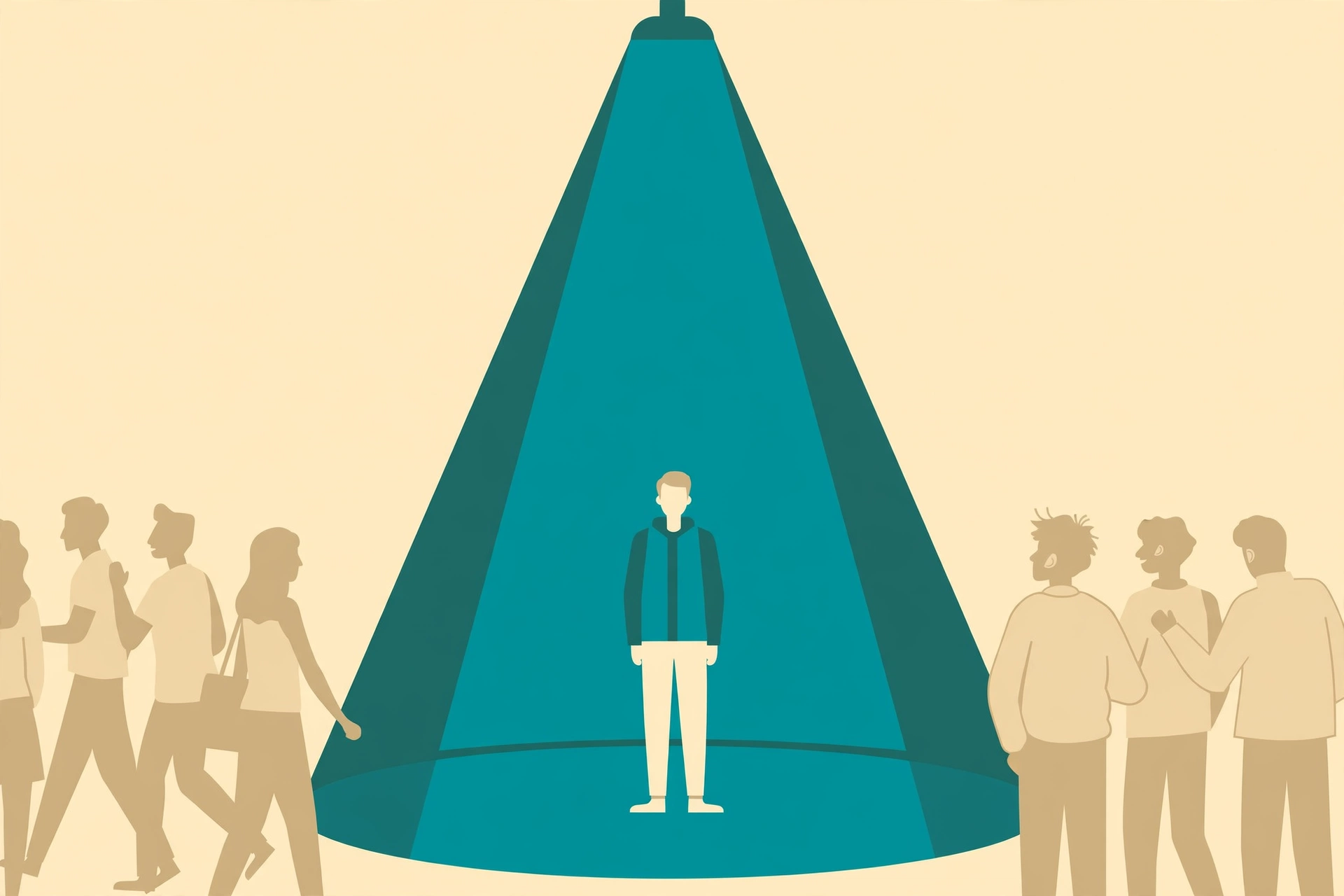
You walk in with a tiny stain. Certain everyone sees it. You stumble over a word — sure they’re judging. Truth: they’re not. They’re busy worrying about their stain, their stumble. This is the spotlight effect — and seeing it quiets social anxiety dramatically.
What it means in one sentence: The spotlight effect is wildly overestimating how much others notice — and judge — our appearance, mistakes, and behavior.
In short: The spotlight effect is our tendency to overestimate how much other people notice us — the stain, the stumble, the awkward comment. In classic experiments, people wearing embarrassing T-shirts guessed far more observers noticed than actually did. Everyone is too busy monitoring themselves to scrutinize you.
Watch: The Psychology of the Spotlight Effect
The Spotlight Effect in Everyday Words
We live in our heads 24/7, assuming others watch us as closely as we watch ourselves. They don’t — they’re also in their heads. Result: a room of people each convinced they’re on stage, for an imaginary audience.
We overestimate by multiples. “Everyone noticed” = “almost no one did.” And when they do notice, they forget in minutes — while we replay for weeks.
The Science Behind It
Gilovich (2000): participants wore embarrassing Barry Manilow shirts, estimated ~50% noticed. Actual: ~25%. We double perceived visibility. Mechanism: egocentric anchoring — we feel embarrassment vividly, then insufficiently adjust for others’ perspective. Observers are busy with their own self-consciousness.
3 Examples From Real Life
Example 1 — Presentation stumble: Mispronounce a word. Internally: disaster. Reality: half thought about lunch; rest forgot in 90 seconds. A week later you still cringe; attendees: “what happened?”
Example 2 — Bad haircut: Dread school — everyone will stare. Day one: one comment. Day two: nobody. Your hair was a headline in your mind, footnote in theirs.
Example 3 — The post: You post, refresh obsessively — what are they thinking? Most scrolled past in 1.2 seconds. Nobody maintains the dossier you maintain. The feared audience is your own self-monitoring, projected.
🧠 Quick check: What is the spotlight effect?
Why: We live in our heads, assume others watch closely. They're watching themselves. Overestimated by multiples.
Try This Today
Spotlight audit: wear something slightly off. Predict noticers. Count actual comments. The gap is the effect, measured. The stage was empty all along.
What People Get Wrong
Myth: “Stop caring = oblivious and rude.”
Reality: It’s about your inflated estimate, not real opinions. Correcting it makes you accurate, not careless. Less anxiety, same manners.
Why It Matters
The spotlight effect fuels social anxiety: every room a stage, every mistake a broadcast. Seeing through it frees behavior — speaking up, asking out, being weird. Most confident people aren’t watched more. They stopped performing for nonexistent watchers.
🧠 Quick check: In Gilovich's t-shirt experiment, what happened?
Why: We consistently double perceived social visibility. The spotlight is mostly in our heads.
Frequently Asked Questions
What is the spotlight effect?
The tendency to overestimate how much other people notice your appearance, mistakes, or awkward moments. You feel spotlit; everyone else is busy with their own spotlight.
What is an example of the spotlight effect?
In a famous experiment, students wearing embarrassing T-shirts guessed about half the room noticed — the real figure was under a quarter. We are the main character in our own heads only.
How do I stop worrying that people are judging me?
Remind yourself of the research: attention is scarce and mostly self-directed. Shifting focus outward — genuine curiosity about others — shrinks the imaginary audience fast.
Is the spotlight effect related to social anxiety?
Closely. Social anxiety amplifies the imagined audience. Understanding the spotlight effect is one of the quickest cognitive tools for loosening its grip.
Try It on Our Site
Try it now: Social Anxiety check-in — measure how much the imagined audience runs your life. Start the check-in →
More tools for this topic:
Related reading: 27. Self-Esteem · 28. Identity · What Is Overthinking?
Tap when this one clicks — your progress is saved on this device.
Why does the spotlight effect get stronger when you are already anxious?
Because anxiety turns your attention inward, and the more vividly you can feel your own embarrassment, the more visible you assume it must be to everyone else. Anxious minds do not just overestimate the audience — they overestimate what the audience can see of their inner state.
A close cousin of the spotlight effect explains this: the illusion of transparency. In experiments by Thomas Gilovich, Victoria Medvec, and Kenneth Savitsky (1998), people who had to give a speech or tell a lie were convinced their nervousness was leaking out for all to see — yet observers rated them as far calmer than they felt. We experience our anxiety from the inside, at full volume, and wrongly assume it is being broadcast at the same volume.
The leading model of social anxiety, developed by David Clark and Adrian Wells, shows how this becomes a loop. In a social situation, self-focused attention rises: you monitor your voice, your face, your hands. That monitoring produces a mental image of yourself as you fear you appear — flushed, awkward, boring — and you mistake that image for what others actually see. Safety behaviours meant to hide the anxiety, like rehearsing every sentence or avoiding eye contact, then keep you from ever learning that people were responding warmly all along. Video-call culture feeds the same loop: watching your own face on screen for hours is self-focused attention with a mirror attached.
Consider Priya, 26, on a video call with her new team. She can see her own thumbnail the whole meeting, notices every pause and half-smile, and logs off certain she came across as nervous and dull. Afterwards a colleague messages: “Great point about the timeline, by the way.” Nobody had been scoring her performance. The only person watching Priya at full resolution was Priya — yet her brain had treated that private broadcast as the public one.
Two quick questions
Is the spotlight effect the same as the illusion of transparency?
They are close relatives but not identical. The spotlight effect is overestimating how much people notice your appearance and actions; the illusion of transparency is overestimating how clearly people can read your inner feelings, like nerves or embarrassment.
Does the spotlight effect apply on social media too?
Yes — researchers call the online version the imagined audience. A post feels exposed to hundreds of watchful judges, but most followers scroll past in a second or two. The audience in your head is far larger, and far more attentive, than the real one.